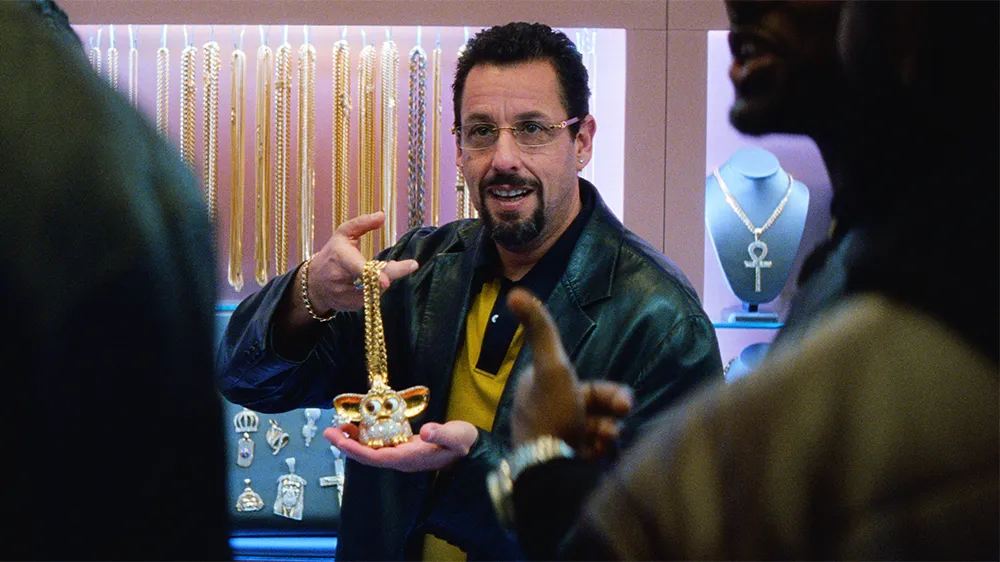
Anxiety is often a battle with your own mind. Days become a fight, while easing your thoughts can be seemingly impossible. It can destroy you, even if it’s a singular issue in your life. Uncut Gems is considered by many to be cinema’s anxiety attack. In my opinion, the film is more like a race with its nervous plot. It’s two laps ahead and forces you to keep up.
The Safdies come from the “Scorsese Film School.” No, that’s not a real establishment, but rather a filmmaking idea. These films are often set in New York City, envelop themselves in crime, and, more often than not, include morally gray leading men. Uncut Gems is no different. Howard Ratner feels right in line with a Henry Hill or Jordan Belfort, while experiencing a lifestyle akin to Paul Hackett’s bizarre late night in After Hours. Martin Scorsese himself was an executive producer, so I’m sure they’re well aware of the film’s non-subtle homage. The film takes the kinetic pacing the legendary director is known for, tightens it, and knocks the breath out of you.
Near the end of Goodfellas, where Henry Hill is doing coke and avoiding his own murder, we want him to survive. He’s charismatic, self-aware, and acknowledged the evil around him. Even if his regret comes from the loss of lifestyle, we find a reason to empathize. When Howard Ratner is almost thrown out of a window by mob goons, we also want him to survive. He doesn’t have that arc or sensibility. The Safdies somehow make us feel pity for someone who has created their own destruction.
The opening minutes of Uncut Gems are almost a smokescreen. It’s atmospheric and patient. We chart through the hypnotic colors of the opal and then the uncomfortable internals of Howard’s colon. You can breathe, you can blink, and you can settle yourself into this story. Then, you’re jolted into the tension. Howard is already scrounging for money and buying his time. This whiplash is consistent with the rest of the film; the quiet moments only last a minute. In one moment in particular, when the anxiety reaches its limit, we almost expect a change, and we are not granted that release.
Towards the 3rd act, Howard’s been beaten to a pulp, both literally and figuratively. Everyone around him has lost respect for him. His wife doesn’t love him anymore. The mob has reached their breaking point waiting for him to pay them back. And importantly, the opal Howard believes is his secret escape plan won’t be purchased by his potential buyer, Kevin Garnett.
He retreats to his office, and for the first time, he seems to understand that he is living on borrowed time. He finds confidence in Julia Fox’s character and breaks down. He starts crying, explaining how screwed his life is. “Nothing is going right.” For a moment, we believe that Howard will change. This is the time when he develops as a character and decides to make things right. It’s the conventional cinema plotline. He’s not evil and unredeemable, but he also hasn’t done anything to warrant our support. However, we feel for him and want him to do better. And then the phone rings, and Garnett wants to pay for the opal. In a masterful performance, a switch goes off in Adam Sandler’s head. In an instant, the teary-eyed Ratner snaps right back into character. He doesn’t even take a minute to collect himself. Like the beginning of the film, the heartfelt moment was a smokescreen.
As someone who deals with anxiety daily, why do I love this movie? It brings out one of the worst feelings I can deal with. The character has no progressive arc, he wins the biggest bet of his life and loses it all. What was the point? That point is that there is none. Sometimes people don’t have points to make and live on an undiscovered death wish. They rush to their own defeat, without even realizing it. The unease will crash, and we will be left in the rubble. Howard’s spiral isn’t a cautionary tale so much as a mirror. One that reflects your own self defeat.